

- MEDITERRANEAN YACHTING MAGAZINE
Mediterranean anchoring, a new balance between freedom, compliance and respect for the sea
AnchorGuardian’s 2026 report helps crews and yacht managers navigate local rules and protected marine areas
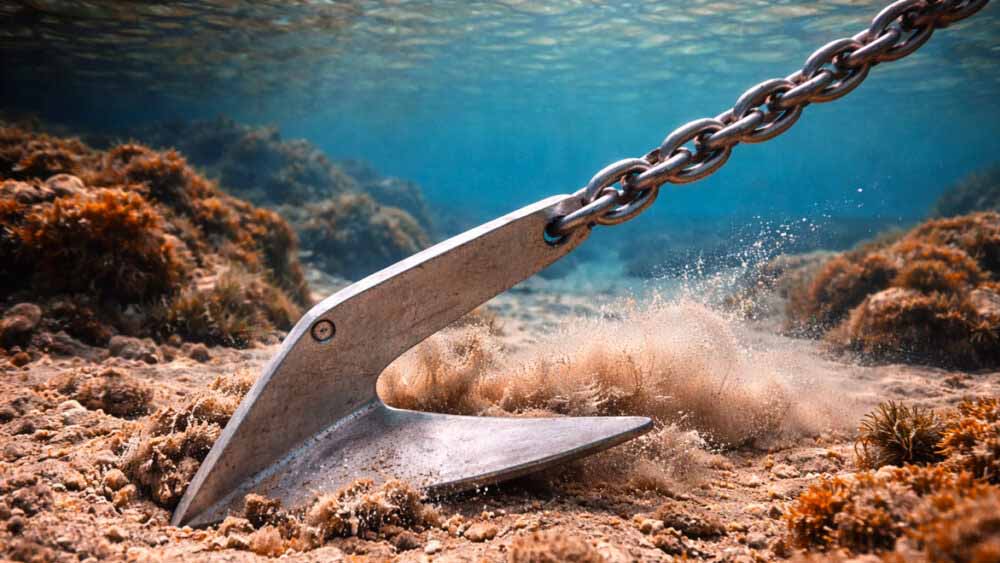
Mediterranean anchoring now requires more planning, with new rules, protected habitats and growing responsibility for captains
In the Mediterranean, dropping anchor is no longer just a familiar manoeuvre shaped by seamanship and experience. It has become an operational decision that requires preparation, local checks and a growing awareness of seabed protection. Between marine protected areas, Posidonia oceanica meadows, seasonal restrictions and rules that may change from one bay to the next, anchoring is now part of responsible voyage planning.
This shift is clearly reflected in the Mediterranean Anchoring Regulations Report 2026, published by Swiss Ocean Tech through AnchorGuardian. The guide is designed for captains, crews and yacht managers operating across key Mediterranean cruising grounds. It brings together publicly available information from official authorities, protected-area managers, harbour authorities and recognised sources, offering a practical starting point for the 2026 season.
A more regulated Mediterranean
The Mediterranean remains one of the most desirable cruising regions in the world, but also one of the most complex from an operational perspective. The report covers France, Spain, Croatia, Italy, Greece, Türkiye, Malta, Cyprus and Monaco, showing how anchoring requirements can vary widely between countries and, in many cases, between neighbouring coastal areas.
The aim is not to make cruising less attractive, but to underline a simple reality: the freedom of the sea increasingly depends on good information before arrival. An anchorage shown on a chart or an app may not be enough to confirm that anchoring is permitted. In several areas, maritime authorities, natural parks, regional administrations or harbour bodies define limits, protected zones, mooring fields, vessel thresholds and seasonal restrictions.
France and Spain in sharper focus
Among the countries reviewed, France stands out for having one of the most detailed regulatory frameworks in the Mediterranean. Restrictions may depend on yacht length, gross tonnage, coastal sector and the presence of sensitive habitats. In parts of the Côte d’Azur and Corsica, thresholds such as 20, 24, 45 and 80 metres can trigger different obligations or limitations. For larger yachts, depth contours such as 30 or 40 metres may also become operational references.
Spain has introduced Royal Decree 191/2026, creating a national framework for the protection of Posidonia oceanica and Cymodocea nodosa meadows in Spanish Mediterranean waters. The Balearic Islands remain one of the most advanced areas for public seabed mapping and practical guidance, but even there, checking official sources before anchoring has become part of proper voyage preparation.
Technology supports, but does not replace judgement
Digital apps, seabed maps and planning tools have made route preparation easier in recent years. Yet the report points to a crucial distinction: useful does not always mean official or exhaustive. Even well-regarded platforms may provide indicative information that still needs to be checked against local orders, notices to mariners, harbour authority guidance and institutional sources.
For captains, this turns anchoring into a documented process. Reviewing the area before arrival, checking restrictions, briefing the crew, updating the voyage plan and, when appropriate, contacting local authorities can make the difference between a peaceful stay and a compliance issue. In a fragmented regulatory landscape, even a radio exchange with a local signal station may become relevant when recorded properly in the ship’s log.
Posidonia as an invisible boundary
Much of the regulatory attention is linked to the protection of Posidonia oceanica, a marine plant that plays a key role in Mediterranean ecosystems. Its meadows support biodiversity, help stabilise the seabed and represent an environmental asset that can be damaged by anchors and chains.
For those at sea, this means learning to read what lies beneath the surface. Sand, rock, seagrass and protected habitats are not minor details; they influence where a vessel can safely and responsibly stop. Responsible anchoring is not only about complying with a rule. It is also about how yachting can continue to enjoy the Mediterranean without adding pressure to its most fragile environments.
Croatia, Italy, Greece and Türkiye rely heavily on local checks
In countries such as Croatia, Italy, Greece and Türkiye, the report highlights the growing importance of local restrictions. A single, easy-to-read national rule is not always available. In many destinations, what matters most may be a concession area, a buoy field, a marine park, a temporary order or instructions from the relevant local authority.
This requires a less automatic and more context-aware approach to cruising. A bay that looks open may fall within a protected area. A familiar anchorage may be subject to new limitations. A destination used in previous seasons may have updated its requirements. Good seamanship now includes this kind of regulatory awareness.
A new anchoring culture
The most interesting message from the report is not only about penalties or compliance exposure. The deeper change is cultural. Anchoring is no longer an isolated action, but a decision that brings together vessel safety, the captain’s responsibility, environmental care and respect for coastal communities.
For the large-yacht sector, this evolution can become a positive signal. Better information, clearer planning and greater seabed awareness can reduce conflicts, mistakes and environmental damage. The sea remains a place of freedom, but that freedom now asks for preparation, attention and the ability to adapt to each destination’s rules.
Better cruising begins before arrival
The Mediterranean Anchoring Regulations Report 2026 does not replace official sources and should not be treated as legal or navigational advice. It is best understood as an information compass for a fast-changing regulatory environment. The report states that its information was reviewed in June 2026 and may change over time, meaning captains, owners and yacht managers should always verify current requirements before anchoring.
In the end, the most elegant route is not only the one that leads to a beautiful bay. It is the one that reaches it with respect, awareness and an anchor dropped in the right place.
__
anchorguardian.com
14 Luglio 2026
© Redazione MED Yachting
https://www.med-yachting.com/magazine/home.do?dettagli=sustainable-anchoring&key=1784027951
__
Le informazioni contenute in questo articolo sono tratte e rielaborate da fonti ufficiali e/o comunicati stampa, nel rispetto del codice etico redazionale.


iscriviti gratuitamente al nostro canale WhatsApp , inquadra o clicca il QRcode


MAGAZINE
YACHTS
LIFESTYLE
EVENTI
Partnership
Disclaimer e publishing
Privacy e Cookies (GDPR)
media@med-yachting.com

Euroblu International
MED | digital publishing
Via Giosué Carducci, 10
00187 Roma IT
PI 11540531008
GoogleMap
© 2019, MED-YACHTING & LIFESTYLE MAGAZINE Tutti i diritti sono riservati.